
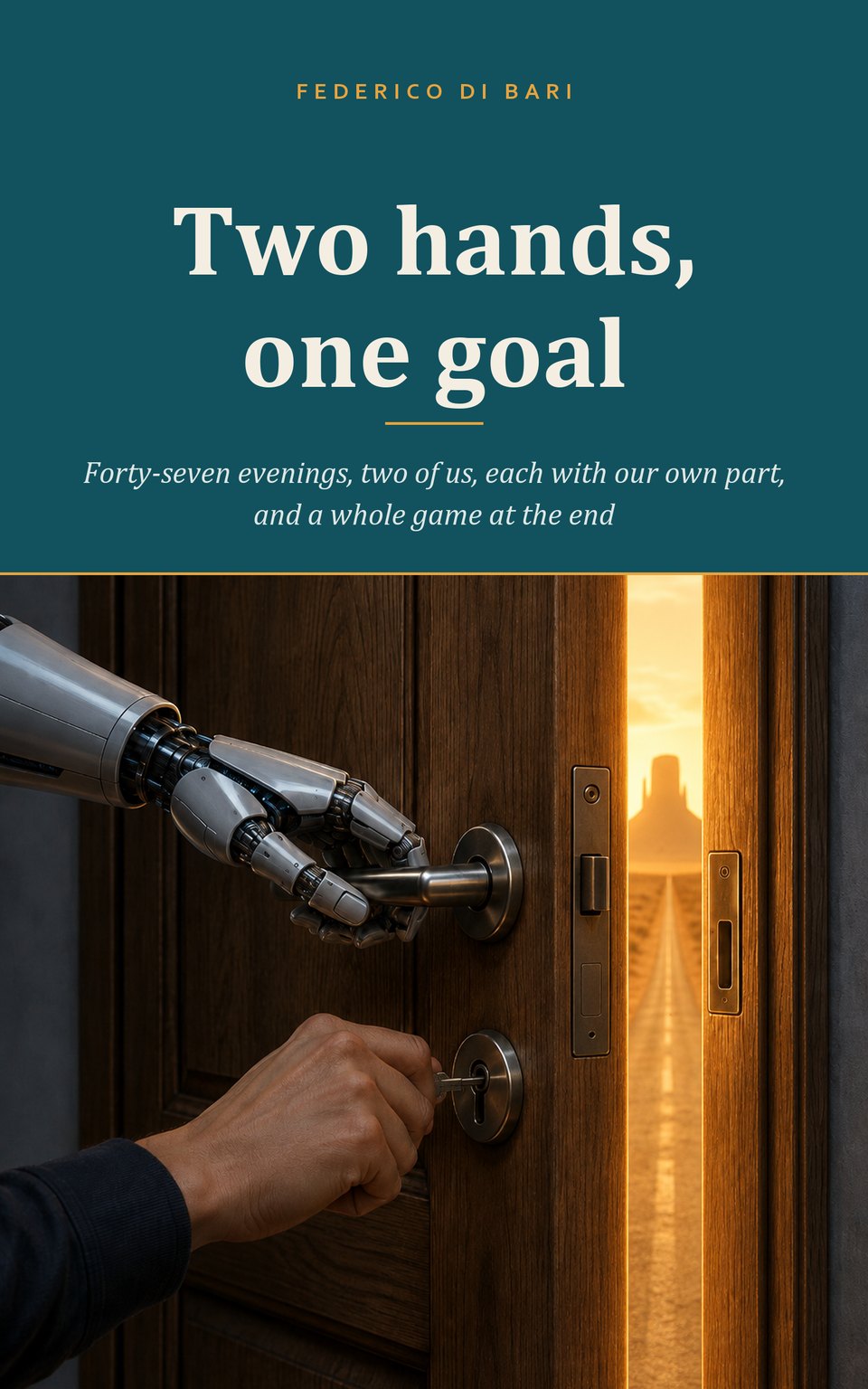
Two hands, one goal
Forty-seven evenings, two of us, each with our own part, and a whole game at the end
A man and a machine built something good, together. This book tells how it went — and between the lines there is the way for anyone to do the same.
I have spent my life writing software people open because they have to. Then I wanted to make something people would open because they felt like it, and I took a second decision: I would not write a line of it.
In 47 evenings, after work, a whole game came out: 49 cars, ten worlds, 240 missions, a journey 40,000 kilometres long.
The game is the proof, though, not the argument. The argument is what really happens when a person and a machine work side by side: who decides what, where the machine is unbeatable, and where — always at the same spot — it does not get there.
The methods are not in one chapter: they are inside the stories
Every chapter leaves you a rule, and explains it where it was born: the evening something was not working, what I tried, what was left of it. That is why there is no list of tips at the end of the book: you have already seen the rules happen. And they hold well beyond a video game:
- Say what effect it must have, not what it must be. A request that describes an object gives you back a ticked list. One that describes an effect on a person gives you a target
- The answer is as wide as the question. Three times I asked about one obstacle and one obstacle was fixed for me, beautifully. The fourth time I asked about all of them, and it was the same amount of work
- Do not ask for more than you can judge. Fifty things delivered together are fifty bets placed the same afternoon, with nobody watching
- Something can work perfectly and still be wrong. No measurement in the world tells you that what you are measuring is of no use
And at the end of almost every chapter there is a note written by the machine, where it says where it got things wrong. It is not a gimmick: it is the method the book was written with.
The promise, and the warning
Because the one thing I learned is a single thing, and it is both at once: the machine multiplies what you bring it. Bring it nothing and it gives you back a great deal of nothing, fast and with the air of having done a huge job. The failure does not show: it looks like abundance.
That is why the book also tells the times it went badly: fifty ideas built to perfection and all to be redone, two hundred and forty missions that worked and were boring, an evening holding a game that ran beautifully and was good for nothing. Those are the chapters where the method shows best.
Who it is for
You do not need to know how to program. You do not need to be an expert in artificial intelligence: I am not one either. You need to be able to say what you want, to look at what comes back without telling yourself stories, and to put yourself in the shoes of whoever will use the thing.
That much you already know how to do.
Who wrote it
Federico Di Bari writes business software for a living. ZighiRun is the first thing he made for someone to open for pleasure, and it is the game this book is about.
The book is out. It is on Amazon as an ebook at $4.99 and in print at $14.99 (£3.99 and £11.99 in the UK), in five editions: Italian, English, French, German and Spanish.
Before you read it
Get the game, it is free on Android (it will come to iPhone later): from halfway through the book on, it talks about that stuff — a corner taken badly, a lion chasing you, a notebook that opens a piece at a time. Having it in your hand while you read changes everything.